CONCEPT REALIZATION
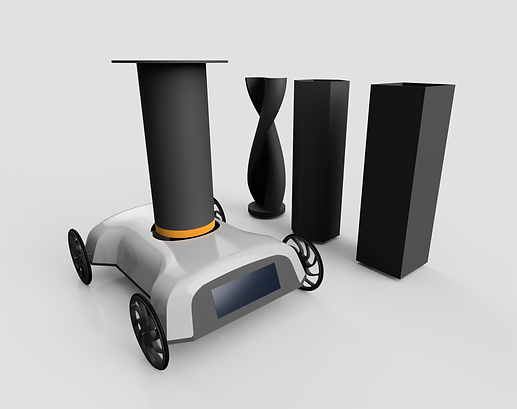
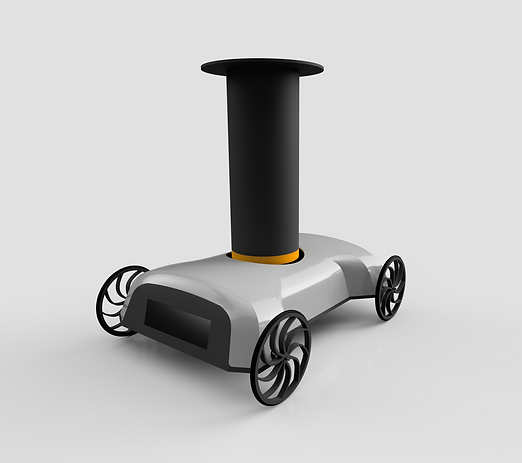
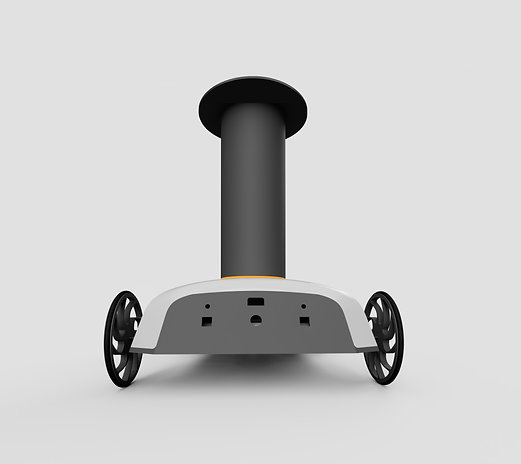
A compromise between lightweight construction and appearance resulted in a sleek design, that covers technical components and allows a quick rotor change.
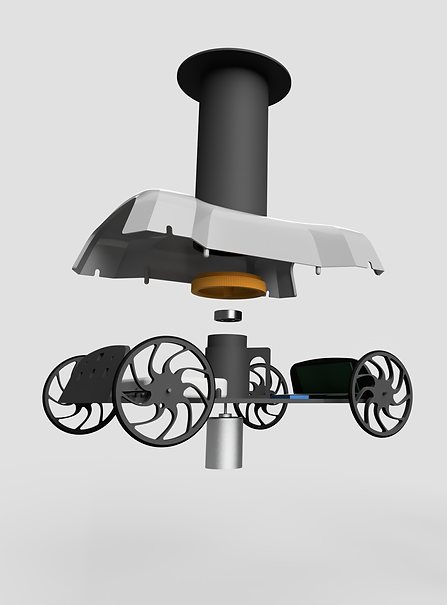
Powerbank
Button (turning direction)
Potentiometer (rpm)
Hall sensor (speed)
Carbon axis + ball bearing
Ball bearing
Rotary plate
Arduino
Hall sensor (rpm)
Switch (on/off)
DC motor
PHYSICAL BACKGROUND
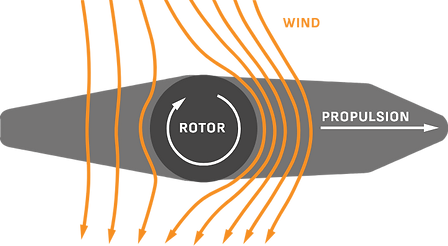
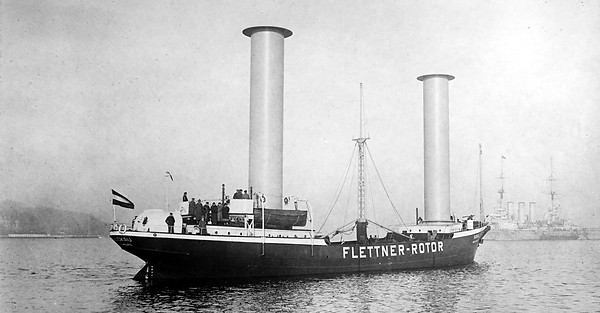
The Flettner rotor is a rotating cylinder which is exposed to a wind stream. Due to the Magnus effect, a force is generated transverse to the direction of wind and triggers propulsion.
REQUIREMENTS
//Creation of a working prototype of a vehicle with design claim
//Realization with an adjustable speed of the rotor
//Easy changing of different rotors
//Use of a DC motor controlled by an arduino as small as possible
//Define & realize a user interface
//Study goal: show the speed of the demonstrator is influenced
by the rpm and the shape of the Flettner-Rotor
10
FLETTNER
TASK
Exploring an overlooked technology: integrating a Flettner rotor onto a ship alongside its propulsion system to significantly reduce emissions. The University of Emden is actively researching ways to improve this technology. As part of this, a model vehicle solely powered by a Flettner-Rotor is to be build to experiment with different variables.
DEMONSTRATOR FOR A MORE ECOLOGICAL SHIP PROPULSION SYSTEM
ROTOR

PRODUCTION METHOD
The vehicle itself (consisting of a base plate, a housing, the various rotors and the wheels) is 3D printed. The hardware components are located on the base plate and are enclosed by the housing for design purposes.

POWER SUPPLY
Power is supplied via a powerbank inside the demonstrator. It can be switched on and off via a toggle switch directly on the vehicle.
A DC motor provides the drive for the rotor. For propulsion, the crosswind is demonstrated by a conventional hairdryer.

ROTOR EXCHANGE
The exchange of the different rotors is done with an internal thread, which allows them to be easily and quickly screwed onto a turntable. The vehicle has also been designed symmetrically so that a direct change of direction is possible.

SPEED CONTROL
The speed of the rotor can be adjusted directly on the vehicle. For this purpose sensors were attached to the turntable and one wheel. The units are controlled via an Arduino. On the front of the vehicle there is an LCD display that shows the maximum speed.